"I want to talk to a Clinic where Joost matters and not Billy The Kit."
Joost Seilberger


Repairing coves is quite possible with a hair transplant. On this page we will tell you more about the cause of coves, what the hair transplant treatment procedure is and what is possible in your situation.
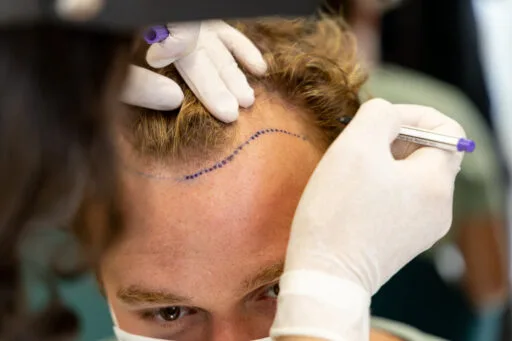

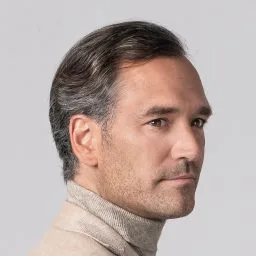
The appearance of coves in a man is often the first sign of male hair loss. Coves occur because the hair slides back from the front line at the level of the temples. For some, hair loss begins around age 20. In others, it is only around the age of 50. In most cases, the cause of the appearance of coves is Alopecia Androgenetica. This type of hair loss is hereditary and is caused by the male DHT hormone. The hair follicles around the inlets in a man may be sensitive to the DHT hormone. As a result, these hair follicles begin to produce an increasingly lower quality of hair, but they also produce hair at a slower and slower rate.
With the advent of the FUE method, hair transplantation has become a more accessible treatment. This causes many people to choose to treat incipient hair loss, such as in the inlets, right away. Hair transplant treatment at the inlets restores the original hairline. Because the hairline runs along the face, filling inlets greatly affects the shape of the face. Bringing back the hair of the inlets not only does something to the model of the hair, but also brings back the proportions of the face. A comprehensive overview of our methods and techniques in hair transplantation can be found here.
Because a hair transplant is much less invasive than it used to be, many people choose to transplant in stages. Hair problems are addressed earlier and the treatment is broken up into smaller treatments. There is no waiting until all the hair has fallen out. An added benefit of this is that there are then options for further hair loss prevention and people can enjoy the results for longer.
Filling in coves with a hair transplant is a relatively small hair transplant treatment. This hair transplant can therefore also be performed hair sparingly in many cases. By treating coves in the hair using the FUE hair saving method, not all hair needs to be shaved. Treatment without shaving is a great advantage with coves. This is especially true for coves in women, who tend to wear long hair. But this treatment is also popular for men with longer hair or hair that has been shaved (semi-hair saving).
With an inlet hair transplant, groups of hair follicles are redistributed from the donor area (usually the back of the head) to the area to be transplanted. A hair transplant is a proven and reliable method of permanently restoring an area where hair has fallen out. A hair transplant takes at least a year to complete. This starts at the first contact with a Clinic and lasts until a year after the treatment. Then the full result of the hair transplant is visible. The main 4 steps in the course of a treatment are:
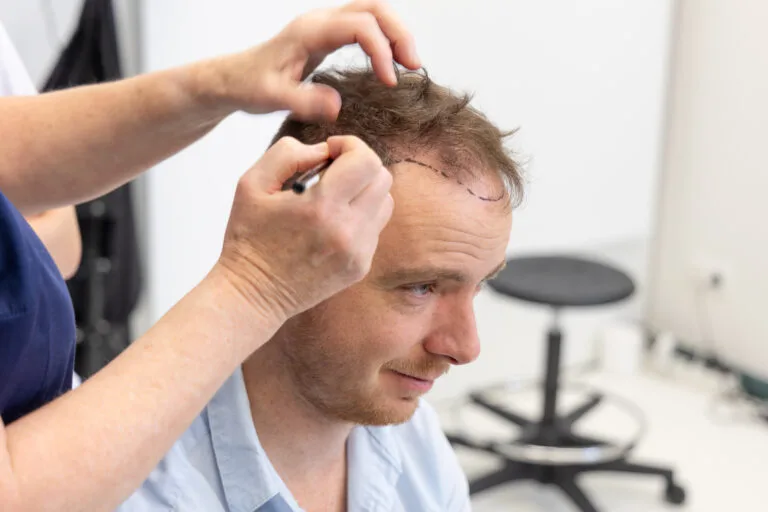
During the consultation, we first carefully review the situation of your hair loss at the coves. We explain to you the different techniques, discuss which treatment best suits your needs and what your options are for the height of your cove hairline. We also look at the direction of growth, the quality of the donor material and your hair volume. We also discuss with you the cost of the hair transplant inlets.
The first part of the treatment focuses on extracting the grafts (groups of hair follicles). First we prepare the donor area for transplantation with a local anesthetic. This is in almost all cases at the back of the head. Then the follicular unitsgrafts) consisting of one to three hairs are removed one by one from the donor area with a hollow needle about 0.5 millimeter to 0.8 millimeter thin.

Based on the information and photo you submit, you will receive advice from a specialist within one working day. We will send you the information by email. If necessary, you can follow this up with a consultation (by phone) for a more detailed explanation.
During the second part of the treatment, the grafts are inserted. In the area to be treated, the doctor makes very small openings in the skin (incisions). Then the grafts are transplanted one by one. Here we place the grafts in the correct direction of the hair, so that the transition of the incisions with the existing hair is as natural as possible.
After your inlet treatment, you will be given aftercare instructions and aftercare products to take home. Recovery is on average 7 to 10 days. That is when the wounds through the incisions are completely healed. The final checkup is one year after the treatment. After the treatment, you can always schedule an additional checkup appointment for questions, or you can consult with your treating physician by phone.
Na meerdere klinieken te hebben bezocht, heb ik besloten om bij Zandman Kliniek mijn haartransplantatie te laten uitvoeren. Naar mijn idee zijn ze ook erg scherp geprijsd.Vanaf het eerste consult voelde het contact bij deze kliniek meteen prettig, eerlijk en natuurlijk aan. Ik kreeg een duidelijk verhaal over wat mogelijk was en wat ik kon verwachten. Dit gaf al veel vertrouwen.Het contact daarna, via zowel e-mail als telefoon, verliep goed en professioneel. Mijn oorspronkelijke behandeldatum lag later dan ik wilde omdat de planning vol zat, maar door de snelle service hebben ze uiteindelijk geregeld dat ik veel eerder geholpen kon worden. Dit waardeerde ik enorm.Op de dag zelf werd alles nogmaals rustig uitgelegd: hoe de dag zou verlopen, wat er precies ging gebeuren en er was alle ruimte voor vragen. De arts en het team eromheen waren vriendelijk, professioneel en betrokken. Tijdens de behandeling viel het me op dat ze elkaar regelmatig afwisselden om scherp te blijven, wat mij alleen maar meer vertrouwen gaf. De sfeer was rustig en voelde de hele dag erg relaxed aan.Nu is het natuurlijk nog wachten op het eindresultaat, maar ik heb er alle vertrouwen in!
Usually, coves are well treatable by means of a hair transplant. In case of incipient coves, it is important to make a good assessment during the consultation about possible future hair loss. That way it can be prevented what solving the current hair problem will later cause a new hair problem. That is the biggest risk of a hair transplant; that the available donor material is not optimally used and distributed.
The number of grafts (groups of hair follicles) required for a hair transplant treatment depends on two factors. These are your personal wishes and the available donor material (usually the back of your head). A small treatment is 500 to 1000 grafts. An average treatment is 1500 grafts. A major treatment is 2000+ grafts. You can request a price and treatment estimate by e-mail. Please send photos of the area to be treated to [email protected]. Include your first and last name, phone number and date of birth. You will receive a price and treatment indication by e-mail within 1 working day.
Immediately after hair transplantation:
Immediately after treatment, small scabs are visible until about 7 to 10 days after treatment. After that, others cannot see that you have undergone scalp treatment.
Following months:
After about 4 to 6 months, hair will begin to grow again in places where you previously had no hair. This is very gradual and will therefore be inconspicuous. The first hairs are slightly finer in structure than the following hairs produced by the transplanted hair follicles. One year after the treatment, the result is fully visible.

A hair transplant is the relocation of healthy hair follicles to bald areas created by hair loss. The FUE method is the most widely used hair transplantation method worldwide. In this hair transplant treatment, groups of hair folliclesgrafts) are removed one by one from the donor area. The donor area in most cases is the back of the head. Then they are placed in the area where the hair has fallen out. In most cases, hair loss is caused by the hair follicles being sensitive to the DHT hormone. The hairs at the back of the head, are insensitive to the DHT hormone and will continue to produce new hairs after relocation. A hair transplant is therefore a permanent and natural solution for treating hair loss.
An inlet hair transplant can be done either as an FUT or FUE treatment. FUE is the most popular treatment method worldwide. With the FUE method, it is often possible to perform the treatment hair-saving (without shaving) for the coves.
The risk of medical complications from a hair transplant is minimal. Superficial wounds in the skin generally recover very quickly. A side note is that the treatment is performed in a designated medical environment and according to proper treatment protocols. At a good hair clinic, this will be in order.
The cost of a hair transplant depends on the number of grafts (groups of hair follicles) needed. A small hair transplant is 500 grafts. A large treatment coves is 1750 grafts.
The hair transplant costs are clearly listed on the page 'hair transplant costs' which can be found in the main menu. This page also lists the available Last Minute dates and other current offers.




Bentincklaan 21A
3039 KG Rotterdam
Netherlands
+31 (0) 10 276 2599
[email protected]